






Origin & Founding Insight
1. Take us back to 2017 and that first Fifth Avenue location. What told you there was a real business here, not just a passion project?
When we opened that first location, I don’t think any of us were sitting around talking about building a global company. We were trying to build a place we’d actually want to spend time ourselves. We loved golf, but it didn’t always fit into everyday life. You needed half a day, good weather and a tee time. We thought there had to be another way to make golf a more regular part of people’s lives.
What gave us confidence wasn’t one big moment. It was watching how people used the space. They’d come in for a lesson and stay for dinner. They’d practice for an hour and then bring coworkers back the next week. Members kept showing up. They weren’t treating it like a novelty. They were treating it like somewhere they wanted to be. That’s when it started to feel like this could become something much bigger than one location.
2. Members reportedly started signing up for lessons at 5 a.m. early on. What did that moment tell you about the gap in the market you’d stumbled into?
It wasn’t really about 5 a.m. It was about convenience. I remember meeting co-founder, Mike Doyle, before Five Iron ever existed. At the time, he was literally teaching golf lessons out of a suit shop in Midtown because there wasn’t a practical place for people to teach or take lessons before or after work. That always stuck with me. People wanted to get better at golf. They just didn’t have a place that fit into the way they actually lived.
When we opened, we saw the same thing almost immediately. People were coming in before work, after work, grabbing a lesson on a Tuesday instead of waiting for the weekend. It reinforced what we’d been thinking all along. If you make golf easier to fit into people’s lives, people will absolutely play more.
3. What wasn’t the golf industry servicing at the time that you built Five Iron specifically to address?
I think there were a lot of barriers that people had just accepted as part of golf. It wasn’t just the time commitment. If you were new to the game, it could feel intimidating. For a lot of people, golf could feel intimidating or exclusive. Whether you were new to the game, didn’t grow up around it or just didn’t feel like you fit the traditional mold, there were barriers that kept people from getting started.We weren’t trying to replace traditional golf because we all love traditional golf. We just believed there should be another way to experience it. The idea was pretty simple. Build a place where someone who’s getting ready for their club championship feels just as comfortable as someone picking up a club for the very first time. Add great food, drinks and hospitality, and suddenly golf becomes something that’s easier to work into everyday life instead of something you have to plan your whole day around.
Growth & Business Model
4. You’ve gone from one location to 48 (and counting) across the U.S., Australia, Dubai, Singapore, India and Spain in eight years. What’s actually scaling here — the real estate model, the membership model, or something else?
People ask that question a lot, and I honestly don’t think there’s one answer. The real estate matters. The membership model matters. The technology matters. But none of those things work by themselves.
What’s really scalable is creating a place people genuinely enjoy coming back to. Golf is what brings a lot of people through the door the first time, but what keeps them coming back is everything around it. It’s the instruction. It’s the hospitality. It’s the community. It’s knowing you can come in for an hour after work or spend an entire evening there with friends.
We’ve always tried to build places that become part of people’s routines, and I think that’s what’s allowed us to grow.
5. How does the membership model flex as you move from a dense market like NYC into very different markets like Dubai or India?
I think people expect the answer to be that every market is completely different. And sure, there are differences. But what we’ve found is that people want a lot of the same things. They want to play more, improve their game and have a place they enjoy coming back to.
Our job isn’t to reinvent Five Iron every time we open somewhere new. It’s to build a great Five Iron and let it become part of the neighborhood. That’s been true in Manhattan, it’s been true in Dubai, and I expect it’ll be true in the next markets we enter as well.
6. You’re citing 150% revenue growth across locations since 2022. What’s driving that — new locations, existing locations maturing, or both?
It’s definitely both. New locations are always going to contribute to growth, but one of the things I’m probably most proud of is seeing our existing locations continue to perform year after year.
That’s important because it tells us people aren’t just coming in once to check us out. They’re becoming members, taking lessons, booking events and bringing friends back. That’s the kind of growth you hope for because it means you’re building something with staying power, not just creating excitement around a grand opening.
As we’ve grown, we’ve also gotten better. Every location teaches us something, and we try to carry those lessons into the next one.
7. Globally year-over-year you’re seeing 51% growth in memberships, 34% in event bookings, 18% in lesson hours and 17% in F&B sales. Which of those numbers surprised you most, and which is most important to the long-term health of the business?
I don’t know if there’s one number. Obviously you look at revenue, memberships and events because they’re all important, but I’ve never believed one metric tells the whole story.
What I like seeing is when everything starts moving in the same direction. Memberships are growing, lessons are growing, events are busy and people are coming back for food and drinks. That usually tells you the experience is working.
It’s easy to chase one number. Building a business where all those things support each other is a little harder, and that’s really what we’re trying to do.
NYC as Proof Point
8. NYC membership across your seven active locations is up over 200% since 2022, with two locations hitting capacity and waitlists this past winter. What does a waitlist tell you that you didn’t already know?
New York has always been special for us because it’s where Five Iron started.
Seeing that response before we even opened was exciting, but I also think it reflects how much golf has changed over the last several years. More people are playing. More people are looking to improve. More people are looking for ways to fit golf into their everyday lives.
For us, the waitlist isn’t really the finish line. It’s a reminder that people have high expectations, and now it’s on us to deliver the experience they expect every time they walk through the door.
9. Women’s Golf Month this June saw a 309% year-over-year increase in NYC members. What’s behind that spike, and is it a trend you’re seeing take hold elsewhere?
We’ve believed for a long time that if you create a welcoming environment and give people different ways to get into the game, they’ll show up.
Women’s Golf Month wasn’t really about running one promotion. It was about creating opportunities for people to take a lesson, meet other golfers, join a league or just come see what Five Iron is all about without feeling like they already had to know how to play.
The response reinforced something we’ve believed from the beginning. There are a lot of people who want to be part of golf. Sometimes they just need the right environment to get started.
NYC as Proof Point
10. NYC is where you started and where you’re opening the new flagship. What does the city continue to tell you as you plan expansion elsewhere?
I think what’s always stood out is that people make time for golf, even in a city like New York. It might not be a five-hour round on a Saturday. It could be a lesson before work, practicing after work or meeting friends on a Tuesday night.
New York has also taught us that if you build a place people genuinely enjoy spending time, they’ll make it part of their routine. That’s been true since the beginning, and it’s something we think about everywhere we open.
The New Flagship
11. 605 Avenue of the Americas is one block from where Five Iron began. Why go bigger and more ambitious in the same neighborhood instead of planting that flag somewhere new?
Coming back to Flatiron felt like a full-circle moment. When we opened our first location, we were just trying to prove the concept. Now we had the opportunity to build something that reflects everything we’ve learned over the last eight years.
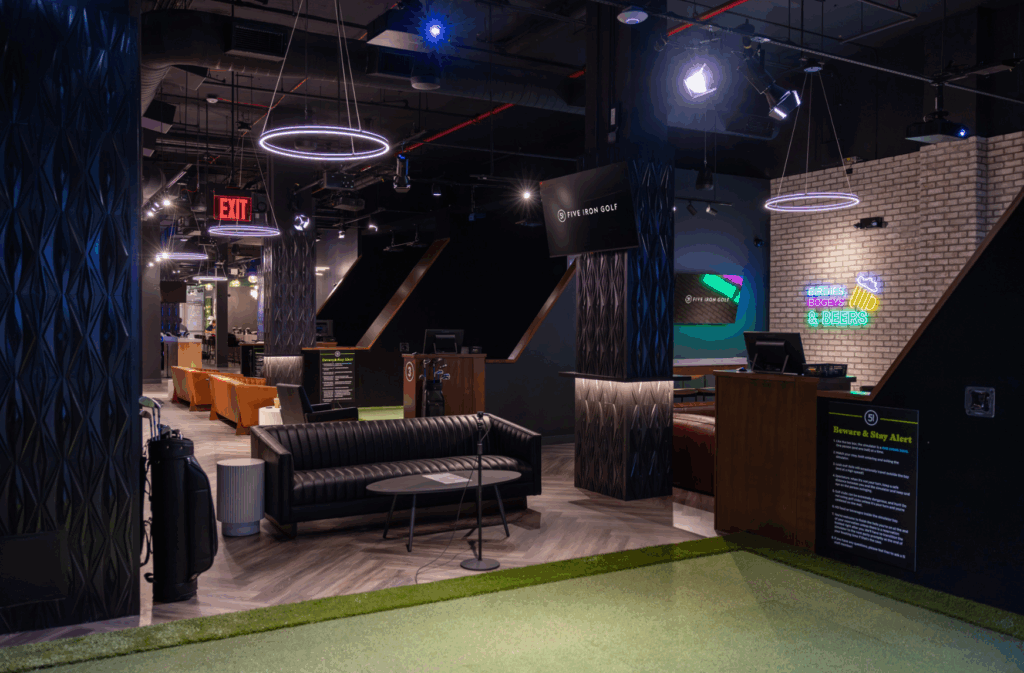
This is probably the most elevated Five Iron we’ve ever built. The artwork is incredible, the design is bolder, the materials and finishes feel more premium and there’s a level of detail throughout the space that makes it really special to us. It still feels unmistakably like Five Iron, but it’s a great representation of where the brand is today.
12. What makes this the brand’s largest and most elevated location yet — what can members do there that they couldn’t at earlier locations?
While this isn’t our largest location, it may be our most meaningful. It’s a homecoming for Five Iron, located just a block from where we first opened in 2017, and many of the members who’ve been with us since the beginning will now call this location home.
We also had the opportunity to push the brand creatively in ways we hadn’t before. The design is our boldest and most out-of-the-box yet, with custom artwork, elevated finishes and thoughtful details that make it feel unlike any other Five Iron while still being unmistakably us.
We expanded the instruction, event and hospitality spaces to create a flagship that reflects how far the brand has come while staying connected to where it all started.
13. Is this flagship a statement about where Five Iron has been, a template for where it’s going, or both?
Probably a little of both. It’s nice to look back and appreciate how far we’ve come because we’ve been fortunate to grow a lot over the last eight years. At the same time, I don’t think we’ve ever looked at Five Iron as a finished product. Every location teaches us something, and those lessons shape the next one.
Accessibility & Category
14. Urban golf is central to your pitch. Who is this actually built for — people who already golf, or people who’d never set foot on a course?
Honestly, it’s built for both, and I think that’s one of the things that makes Five Iron unique. We have members preparing for club championships and people picking up a golf club for the very first time. We never thought those had to be two different businesses.
As we’ve grown, we’ve found more ways to support golfers wherever they are in that journey. We’ve expanded our junior programming, including launching PGA Jr. League in New York, because introducing kids to the game early is incredibly important.
We’ve also built Five Iron Tournaments, which has been a really exciting evolution for us. Instead of waiting for a weekend tournament or coordinating a foursome, golfers can compete in a variety of formats against players across our network on their own schedule. Some tournaments are just for fun, others offer cash prizes, but the bigger idea is making competition more accessible and giving people another way to stay connected to the game.
15. What impact do you think venues like this have on non-golfers specifically — is there a conversion story here, or is it a different audience entirely?
Absolutely. We see it all the time. Someone comes in for a birthday party, a work event or because a friend invited them, and somewhere along the way they decide to take a lesson, join as a member or come back to practice. That’s one of the coolest parts of what we get to do.
Golf can seem intimidating from the outside, but once people experience it in a relaxed environment, a lot of those perceptions disappear. They realize they don’t have to be good to enjoy it, and for a lot of people that’s where it starts.
What’s Next
16. With 500+ simulators, 8,000+ members and 2,000+ employees today, what does the next phase of growth look like — more density in existing cities, or more new markets?
I think it’s a combination of both. There are still a lot of markets, both in the U.S. and internationally, where we think Five Iron belongs. At the same time, we’re excited to continue growing in cities where we’ve already built a strong community.
We’ve never been interested in growing just for the sake of growing. Every location has to make sense, and every new opening has to deliver the experience people have come to expect from Five Iron. That’s been our approach from the beginning, and I don’t see that changing.
17. If the first Fifth Avenue line at 5 a.m. was the signal that started all this, what’s the equivalent signal you’re watching for now?
Back then, we were just hoping people would show up. Today, it’s completely different. It’s seeing members who’ve been with us for years. It’s watching someone who first came in for a company event decide to take lessons or become a member. It’s seeing kids come through our junior programming and develop a love for the game.
Those are the moments that tell me we’re building something that lasts. That’s always been the goal. Not just to give people another place to play golf, but to create a place they genuinely enjoy coming back to.
Jared Solomon, CEO and Co-Founder
Jared Solomon is the co-founder and CEO of Five Iron Golf, the global leader in indoor golf, entertainment, and events. Since launching the brand in 2017, he has guided its expansion from a single New York City location to over 30 venues worldwide, with more than 50 in development.
In 2025, Jared was named an Entrepreneur Of The Year® 2025 New York Award winner by Ernst & Young LLP (EY US), recognizing his vision and innovation in redefining the golf and hospitality experience. Under his leadership, Five Iron Golf has become synonymous with dynamic, art-infused spaces that blend cutting-edge golf technology, hospitality-driven service, and bold design to create venues that welcome both golfers and non-golfers, foster community, and make the game more accessible to all.
Born and raised in New Hope, Pennsylvania, Jared graduated from Germantown Academy, earned his B.A. in Philosophy from Hamilton College, and received his J.D. from Columbia Law School. He began his career as an equity options market maker in New York City before turning to entrepreneurship. He lives in Briarcliff Manor, New York, with his wife and co-founder, Katherine, and their two children.