





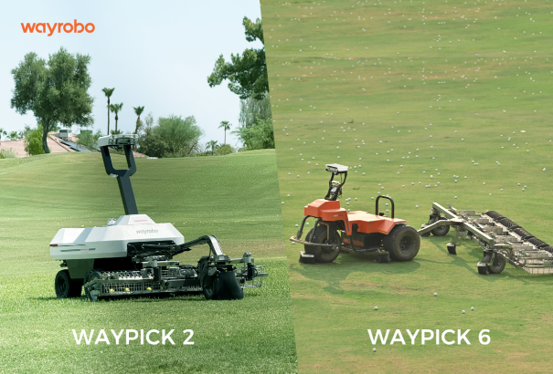

Ball collection and bunker raking are essential jobs on any golf facility, but both are repetitive and time-consuming. Wayrobo’s WayPick and WayRake 9 are designed to take care of these daily tasks, giving teams more time for other work around the course.
WayPick Robotic Golf Ball Picker
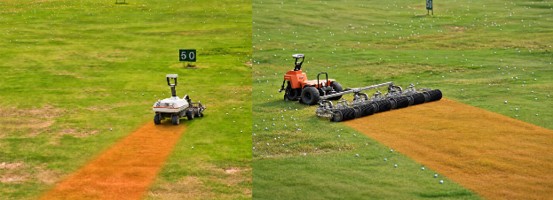
WayPick offers two options for different driving range requirements. WayPick 2 is more compact and agile, making it suitable for ranges that require greater flexibility and manoeuvrability. WayPick 6 is designed for larger, more open and relatively flat driving ranges, with six picking units for wider collection.
Both models are built around the same autonomous approach, allowing golf facilities to choose the right collection capacity for their operation.
Set-and-forget autonomy
WayPick 2 is an autonomous golf ball picker designed for daily driving range collection with minimal staff involvement. It can run for up to 10 hours per charge, cover up to 50,000 m² and collect up to 40,000 balls a day.
Once it starts working, WayPick 2 handles the collection cycle on its own. When the basket is full, the automatic golf ball picker returns to the unloading station, empties the balls and goes straight back to work. Staff do not need to follow the robot or stop it for unloading, which can help reduce labour and overtime costs by up to €30,000 a year, depending on the operation.
Think like a driving-range manager
WayPick 2 does more than follow a fixed route. It can identify areas with a higher concentration of balls and give them priority. Operators can also set different collection plans through the app, making it easy to adjust for busy weekends, quieter weekdays or night-time collection.
The result is a robotic golf ball picker that can adapt to how the range is being used, rather than simply following the same route every time.
More capacity for bigger ranges
For larger driving ranges, WayPick 6 uses six picking units and can collect up to 6,000 balls per cycle, compared with 2,000 for WayPick 2.
Its wider picking system is designed for higher ball volumes and larger collection areas, while keeping the same autonomous approach.
WayRake Robotic Bunker Rake
A simpler way to handle bunkers
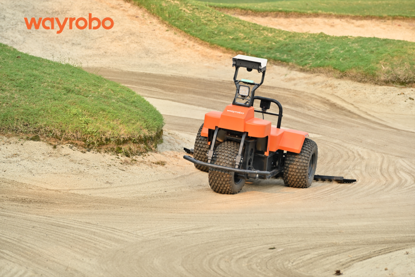
WayRake 9 can cover nine holes on a single charge. When power runs low, it returns to the charging station and recharges automatically.
With routine raking handled autonomously, maintenance teams have more time for other work around the course.
Switch the route to keep sand more even
Using the same raking route every time can move sand to the same places. WayRake 9 allows different routes to be used on different days or weeks, helping reduce repeated tracks and keep sand more evenly distributed.
Ready for different bunker conditions
No two bunkers are exactly the same. Some have steeper slopes, while others have softer sand or more changes in height.
WayRake 9 uses AI 3D terrain mapping to understand the shape and slopes of each bunker and plan its route accordingly.
Wayrobo in the UK and Ireland
Wayrobo supports golf facilities and driving ranges across the UK and Ireland, with service coverage in several English cities, including London, Portsmouth, Southampton, Manchester, Birmingham and Liverpool, as well as locations in Scotland and Ireland.
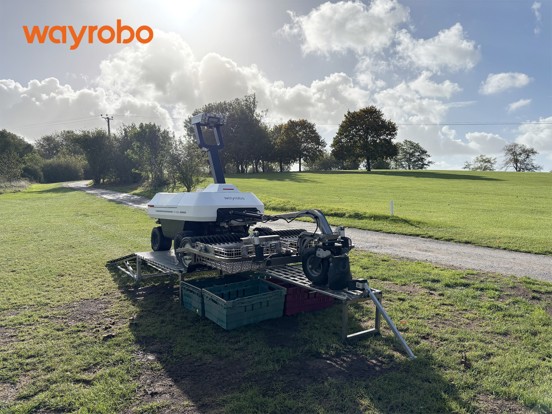
The company has maintained an active programme of events and customer engagement in the UK and will be exhibiting at BTME 2027 in January 26-28th at Harrogate. It is also inviting golf facilities and driving ranges to take part as pilot sites, giving operators the opportunity to assess autonomous ball collection and bunker maintenance in real working conditions.
Alongside its work with individual facilities, Wayrobo is keen to collaborate with golf associations and industry organisations. These partnerships can help share practical experience, support the development of local driving ranges and encourage wider, well-informed adoption of autonomous technology.
For golf facilities, greenkeepers and driving-range operators, WayPick and WayRake 9 offer a practical way to automate two recurring tasks while allowing teams to focus on the wider demands of course and range management.