





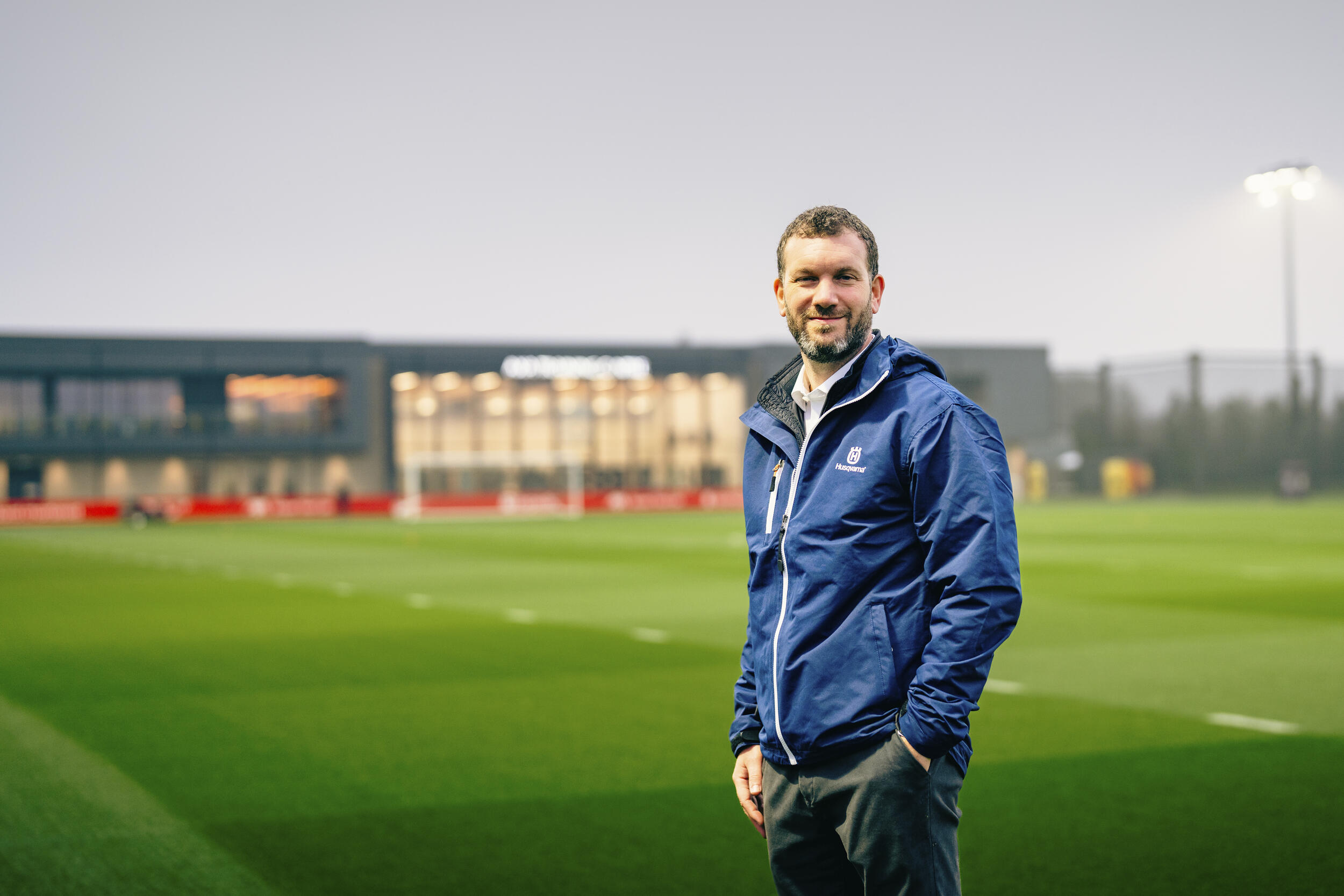

1. Andrew, this is Husqvarna’s first year as title sponsor rather than just an equipment presence. What does that step-up actually change on the ground?
For us, it represents a much deeper partnership with the DP World Tour and an opportunity to show what Husqvarna can bring to golf beyond our traditional equipment presence.
Becoming title sponsor reflects our commitment to the game and gives us a much bigger opportunity to engage with the industry. It also puts Husqvarna at the heart of a championship where performance standards are incredibly high, which is exactly where we want to be.
2. How does this partnership go beyond branding around the event?
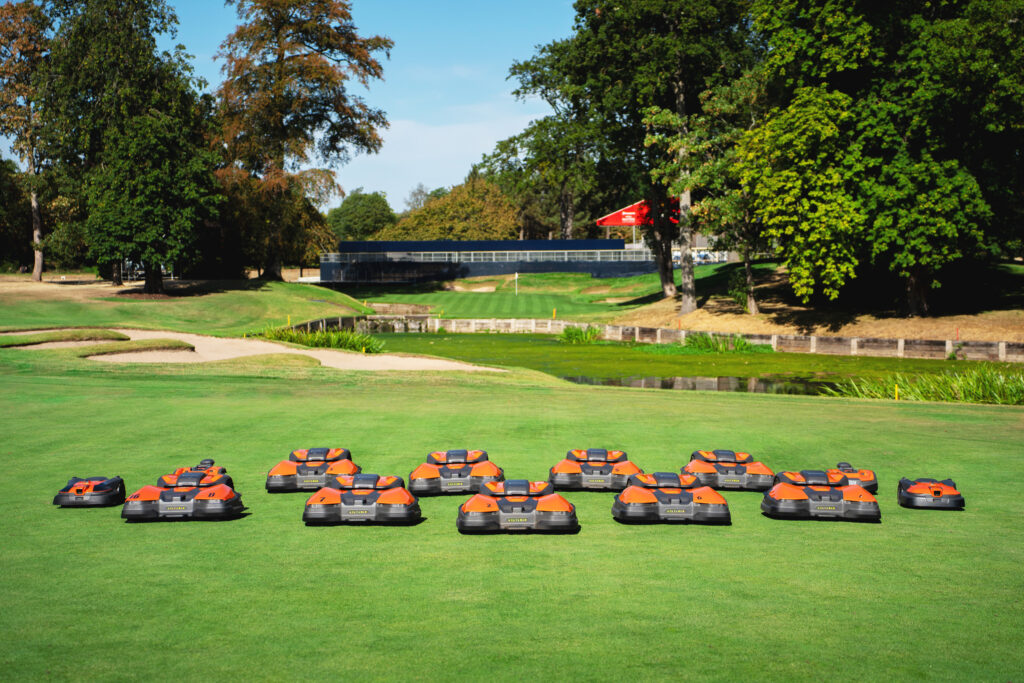
The important thing for us is that there is real substance behind the partnership. Our technology is being used here at The Belfry, so we have an opportunity to demonstrate these solutions in a genuine golf course environment rather than simply talk about them.
We’re also using the week to bring people together from across the industry and enabling conversations about where golf course management is heading. So, there’s the tournament sponsorship, but behind that there’s a much broader conversation around technology, sustainability and the future of the industry.
3. Walk us through what preparing the Brabazon for a DP World Tour event involves. Where does the planning actually start?
From Husqvarna’s perspective, the planning starts by understanding exactly what the venue requires and how our technology can make the greatest contribution.
That means looking at the areas to be maintained, the standards that need to be achieved and how the deployment needs to develop as tournament week approaches. The aim is to make sure the technology is fully integrated into the maintenance programme well before the demands of the event reach their peak.
4. How far out from tournament week does that process begin, and how does it build up as the event gets closer?
The preparation starts a long way ahead of tournament week. We first demonstrated the technology here at The Belfry last year, so there has been a gradual process of understanding where it can fit into the course-maintenance operation and building from there.
As you get closer to tournament week, naturally the intensity increases, and we start cutting in tournament mode the week before the event. Across the two professional Tour events we’ve supported on course, the 2025 AIG Women’s Open and this event, our role has then built into a much larger tournament operation, with additional machines and a dedicated Husqvarna team working alongside the greenkeeping team throughout the week.
5. What’s different about preparing a four-time Ryder Cup venue compared with a typical tournament course?
The expectations are incredibly high. The Brabazon is one of the most recognisable tournament courses in Europe and during the Husqvarna British Masters hosted by Sir Nick Faldo it is being presented to a global audience.
From our perspective, that means the technology has to deliver at a very high level. Reliability, precision and consistency all become absolutely critical, because there is very little margin for variation in a tournament environment like this.
6. How do you think about consistency and presentation specifically? What are you actually trying to achieve out there?
For us, it comes down to precision and repeatability. You want the technology to deliver the same standard consistently across the areas it’s maintaining, particularly in a tournament environment where presentation is so important.
CEORA® works systematically within digitally defined areas using satellite-based EPOS® navigation. That allows us to work very precisely across large areas and deliver a consistent, repeatable cut throughout the course.
7. What’s actually out on the course, and how has the deployment changed for tournament week itself compared with the run-up?
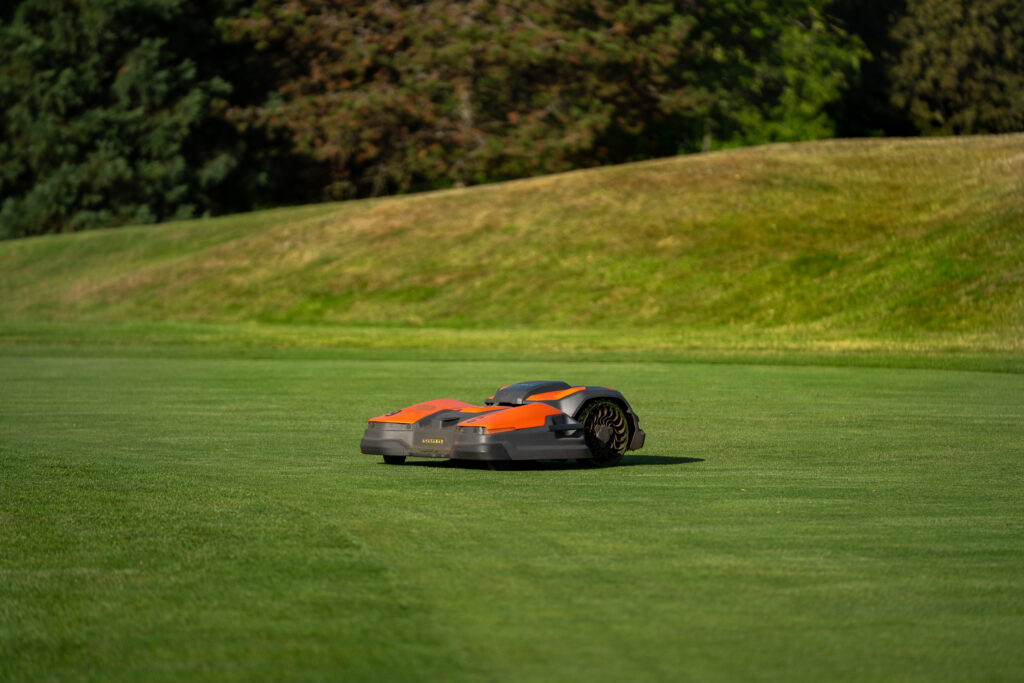
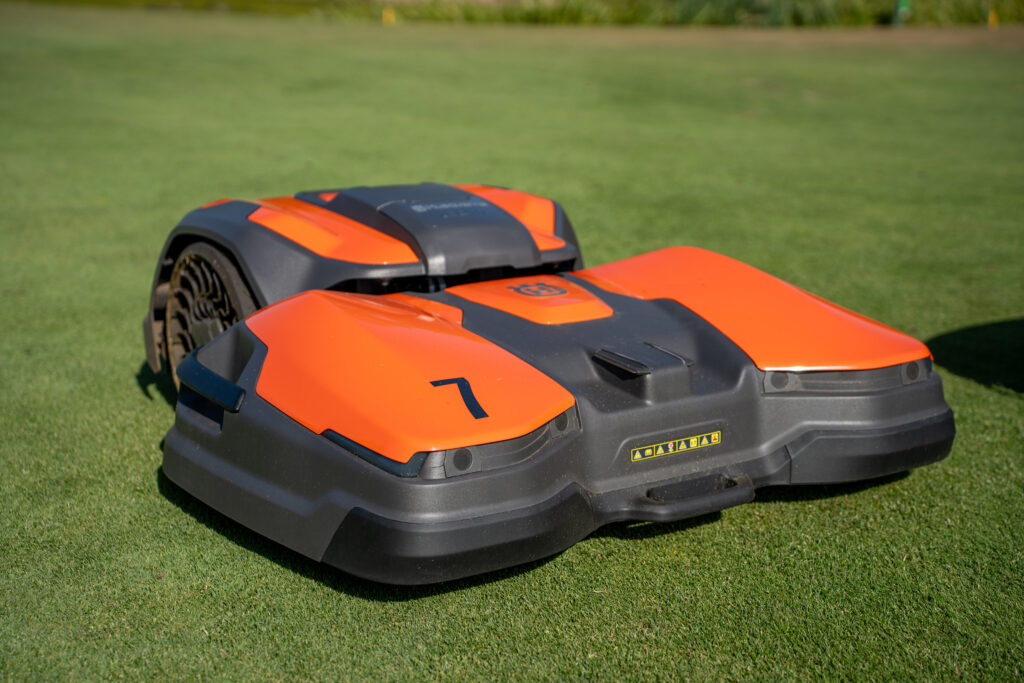
We’ve had seven CEORA robotic mowers maintaining the fairways during the build-up. For tournament week that increases to 16 CEORA units, cutting the championship fairways overnight.
We also have technology working elsewhere around the site. CEORA, Automower 580L and RELOX are being deployed on the driving range, while a 535 AWD EPOS is maintaining the short-game area. Alongside that, The Belfry team has access to our professional battery handheld equipment.
So it’s quite a comprehensive deployment across the venue rather than simply putting robotic mowers on the fairways.
8. How does the technology itself work? What’s keeping the autonomous fleet cutting fairways to tournament tolerances overnight without a greenkeeper walking behind them?
CEORA uses our satellite-based EPOS technology to navigate systematically within virtual boundaries, with accuracy down to 1cm. That allows us to define precisely where each machine needs to work without physical boundary wires.
But autonomous doesn’t mean unattended. During tournament week we have a dedicated Husqvarna team working overnight. They deploy the machines, oversee the operation and make sure everything is ready for the following day’s play.
9. How does the handheld side of the fleet fit in alongside the autonomous machines?
They perform very different but complementary roles.
The autonomous machines are particularly well suited to larger, repetitive mowing tasks. Battery-powered handheld equipment then enables the greenkeeping team to carry out the more detailed work around tees, bunkers, trees and course furniture.
It’s about having the right technology for each job and allowing the different parts of the fleet to work together as one overall course-maintenance solution.
10. How much are you and the team still directing that technology day to day versus letting it run on its own schedule?
The machines may be autonomous, but the greenkeeping team remains in control. Work areas and mowing schedules can be managed digitally and adjusted according to the needs of the golf course.
That’s an important distinction. Automation isn’t about removing human decision-making. It’s about automating the repetitive physical task while allowing the greenkeeper to decide what gets cut, where and when.
11. How have Husqvarna and The Belfry actually worked together in the build-up? Was this a case of dropping equipment on-site, or has it been more collaborative than that?
It’s very much a collaboration. You can’t simply deliver a fleet of autonomous machines and expect to get the best from them.
We’ve worked closely with Angus Macleod, Director of Golf Courses & Estates at The Belfry, and his team to integrate the technology into their operation and understand what they need from it. The greenkeepers know this golf course better than anybody, so their expertise has to be at the centre of how the technology is deployed.
12. Andrew, how does this deployment build on what Husqvarna learned from previous major events?
Royal Porthcawl and the 2025 AIG Women’s Open was an important experience for us. We had 15 CEORA robotic mowers working there, which demonstrated what the technology could do in a major championship environment.
One of the biggest learnings was that successful deployment isn’t just about the machines themselves. Planning, technical support, daily maintenance and close collaboration with the greenkeeping team are all essential. We’ve been able to bring that experience into what we’re doing here at The Belfry.
13. What did The Belfry need to see or agree before bringing a fleet like this into a tournament-critical environment?
There has to be confidence in the technology. When you’re preparing a golf course for a DP World Tour event, reliability and quality of cut aren’t negotiable.
That’s why integration ahead of tournament week is important. It gives the course team experience of the technology and allows it to become part of the maintenance operation before you reach the most demanding point of the year.
14. Zooming out, why does this matter beyond one tournament week? What’s the wider case for autonomous equipment in golf course management?
This is where the bigger opportunity really sits.
Golf courses are under pressure to manage resources more efficiently while continuing to deliver excellent playing conditions. Autonomous technology can take responsibility for repetitive mowing tasks and allow skilled members of the team to spend their time where their expertise has greater value.
At the same time, you’re changing how that mowing is carried out. You’re moving towards electric, autonomous equipment that can work regularly and efficiently. So the opportunity goes beyond labour efficiency, with changes to how courses use equipment, manage turf and approach their day-to-day operations.
15. How does the shift to battery-powered and autonomous equipment change the environmental footprint of running a course like this?
There are some very tangible differences. Battery-powered equipment produces no direct exhaust emissions during use and operates much more quietly than conventional petrol or diesel equipment.
Robotic mowing also changes the way you maintain the turf. Robotic mowers can work little and often and, because they are lighter than many conventional ride-on machines, they can reduce the amount of heavy machinery travelling repeatedly across the course.
For us, it’s about looking at specific areas such as direct emissions during operation, noise, energy use and how equipment is used across the golf course, and understanding where technology can help course managers use resources more efficiently.
16. Where do you see this technology heading over the next few years, for The Belfry and for golf course management more broadly?
I think we’re going to see robotics become increasingly integrated into everyday course management.
The conversation is already moving beyond simply asking whether an autonomous mower can cut grass. It’s becoming about how you manage fleets intelligently, how different technologies work together and how the data available to course managers can help them make better decisions.
For me, the really interesting future is where robotics becomes part of a much more connected approach to managing a golf course, helping teams make better use of their time, equipment and resources.
17. What do you most want people watching the Husqvarna British Masters at home to take away from this?
I’d like people to appreciate just how much expertise and work goes into presenting a golf course at this level and also see how that work is evolving.
Technology has never replaced the skill of the greenkeeper. Throughout the history of golf, it has given those teams new tools to help them deliver the standards expected of modern golf courses while making better use of their time and resources.
For us, having that technology working behind the scenes at the Husqvarna British Masters is a great opportunity to show what the future of course management can look like.