






The Pinnacle World Long Drive Tour(WLD) Director of Partnership Chris McLendon and VP of Operation Mike Ambriz share insights on how deploying their first-ever robotic picker optimized event efficiency, reduced labor overhead, and elevated player experience without disrupting the game.
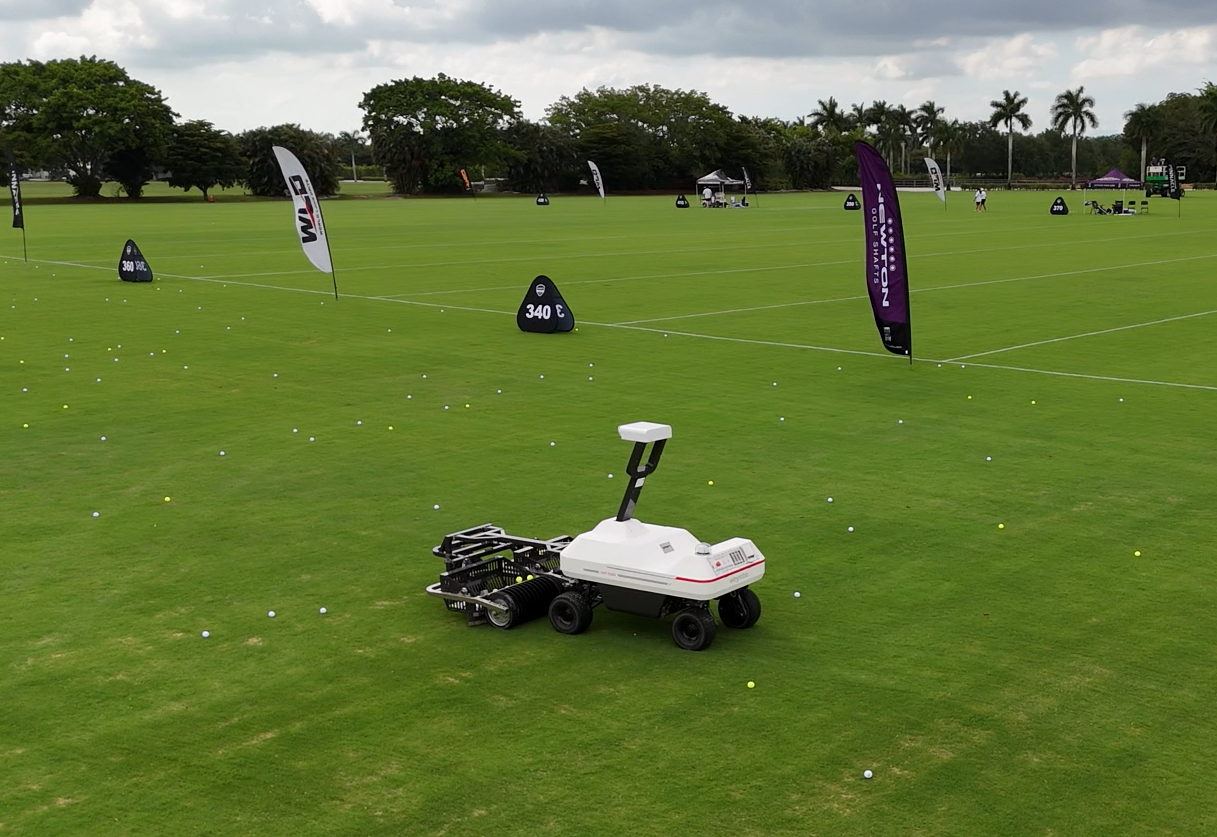
To the spectators and athletes at the recent Pinnacle World Long Drive (WLD) tour event, it looked like a beloved Pixar character had stepped off the screen and onto the driving range. Dubbed “Wall-E” by captivated crowds and players, a sleek, white autonomous ball-picking robot became the unexpected star of the tournament grounds. But beyond the pop-culture charm, this robot — developed by Wayrobo — marked a historic milestone for golf event logistics, representing the first time in WLD history that autonomous technology was deployed to handle range operations.
Learn About Wayrobo: www.wayrobo.com
The integration of Wayrobo signaled a complete departure from industry traditions, replacing manual, caged range-pickers with a seamless, continuous, and un-crewed solution. For an event defined by high-velocity impacts and chaotic ball dispersion, range management has traditionally been an operational bottleneck. WLD’s leadership admitted they previously had to rely on traditional human-driven carts — a method that frequently required halting or adjusting the pace of competition to allow the range to be cleared.
Wayrobo robotic golf ball picker automatically collecting golf balls at WLD tournament.
Non-Stop Efficiency on the Field
The introduction of Wayrobo completely eliminated these disruptions. Because World Long Drive competitors are known for maximum distance rather than pinpoint accuracy, golf balls scatter across every corner of the grid. Wayrobo’s autonomous navigation allowed it to continuously patrol the entire field without interrupting the athletes.
“This was our first time ever to use a robot, and it completely changed how we function,” said Mike Ambriz, VP of Operations at WLD. “With a traditional range picker, you have to make adjustments or stop the competition. Wayrobo helped us keep the movement going. As long as the battery lasted, the robot kept picking. Our players always had golf balls ready for warm-ups, and we never had to wait.”
WLD officials noted that the robot effectively saved nearly an hour of tedious manual labor every single day, maintaining an uninterrupted recycling loop of the event’s limited spare ball supply.
Solving the Labor and Safety Equation
Beyond sheer efficiency, the deployment of Wayrobo directly addressed two of the biggest pain points in modern sports event management: on-site safety and escalating labor costs.
Manual ball collection inherently exposes range staff to the physical danger of being struck by high-speed balls. By removing personnel from the field, WLD completely neutralized this liability.
From a budgetary standpoint, organizing marquee golf events requires flying in specialized crew or hiring local temporary labor—costs that easily fluctuate between $300 to $400 per day per worker, plus travel expenses. Wayrobo reshaped this financial framework by reducing the manpower requirement to a single on-site technician who mapped out the venue’s GPS coordinates prior to the event and monitored the robot effortlessly from a central base camp.
“It made us feel a lot better not having to put someone in a cart and send them out there,” Ambriz explained. “But it’s more than just the time saved—it saved us from having to source, hire, and allocate extra resources for caged golf carts and staff. It allowed us to be lean, efficient, and focus our human staff on areas where a robot can’t operate, like hospitality and clubhouse operations.”
Traditional Manual Picking vs Wayrobo Autonomous Picking
| Traditional Manual | Wayrobo Autonomous |
| $300 – $400/day labor Pauses competition Safety liability risk | 1 Technician (Base Camp) 100% Continuous play Zero human field hazard |
Wayrobo autonomous ball-picking robot nicknamed “Wall-E” at the World Long Drive range.
From Viral Curiosity to Commercial Demand
While WLD’s leadership admitted they initially went into the partnership “blind”—having only seen robotic concepts online—the real-world performance of the machine vastly exceeded expectations.
“The players and the crowd thought it was incredibly cool,” recalled Chris McLendon, Director of Partnerships at WLD. “A lot of people on-site were literally calling Wayrobo ‘Wall-E.’ It completely exceeded what we envisioned a robotic picker would look like.”
This on-field charm quickly translated into genuine B2B commercial interest. According to McLendon, the robot’s ease of operation caught the eye of industry insiders. Several visiting golf course owners and driving range operators approached WLD management during the event, eager to connect with the technology representatives on-site to discuss adopting Wayrobo at their own commercial facilities.
Driving the Future of the Sport
As technologies like digital ball-tracers and advanced simulators continue to reshape golf entertainment, automation is cementing its place as the next logical step for physical facility management. WLD’s leadership views this successful pilot not as a threat to tradition, but as an essential evolution.
“There is absolutely room for both new technology and traditional hospitality in golf,” Ambriz concluded. “Wherever you can protect your bottom line and improve efficiency, you do it. Wayrobo proved it can do exactly that, and we look forward to continuing this partnership in our upcoming events.”